Melete
Practice
The work of repeating until a form will hold.
What must be remembered?
Not merely recall. Continuity. Identity. Oral transmission. Poetry. Song. History. Genealogy. Ritual. Culture. Inheritance. Art. Story. Consciousness. The human refusal to let everything disappear.
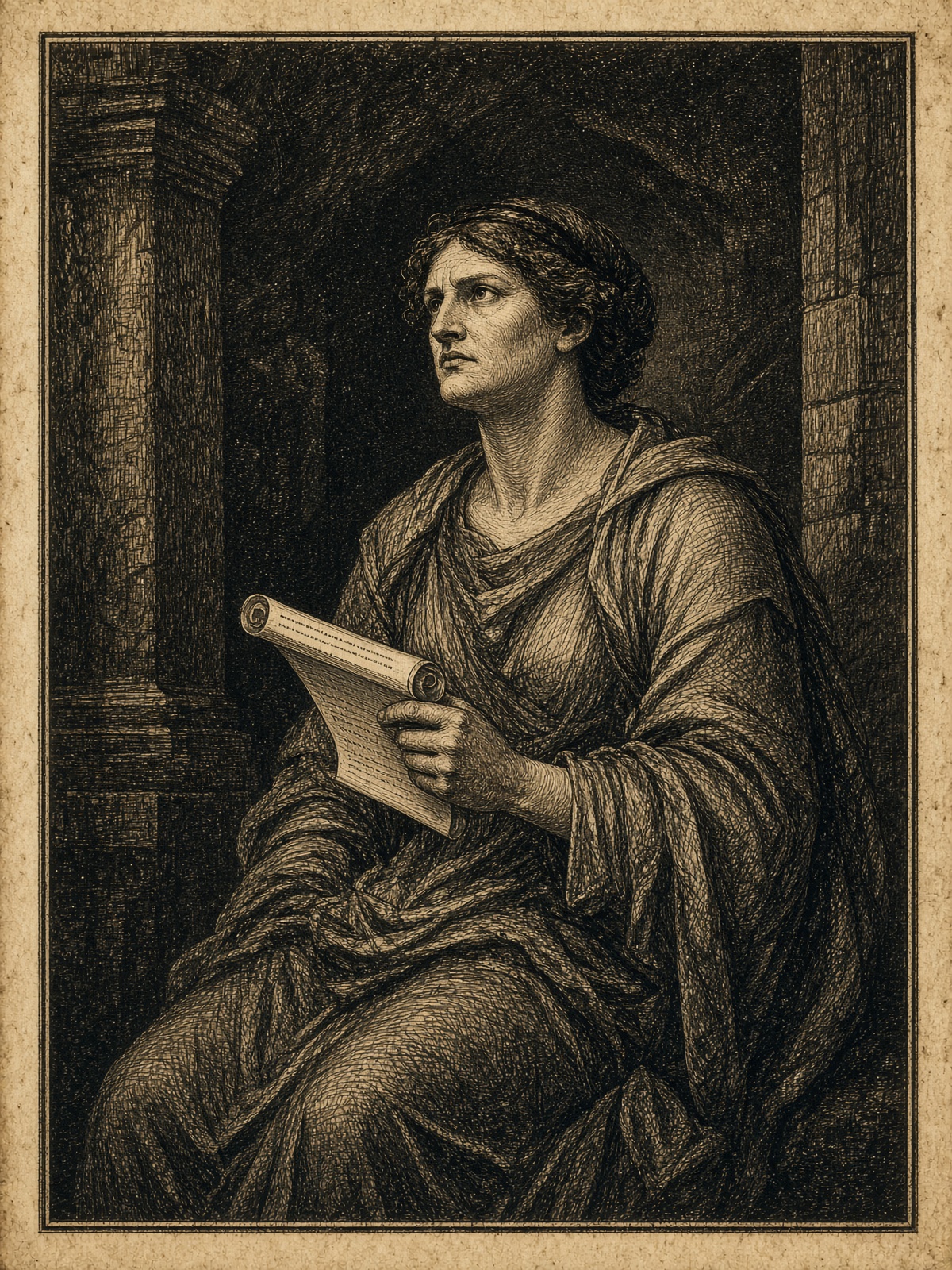
I · The one who remembers
Mythic
In Hesiod’s Theogony, Earth (Gaia) lies with Sky (Ouranos) and bears the Titans. Among them: Oceanus, Coeus, Crius, Hyperion, Iapetus, Theia, Rhea, Themis, Mnemosyne, Phoebe, Tethys, and after them, Cronus.
Mnemosyne is not a late helper in this genealogy. She belongs to the older divine generation. Her name is the Greek word for memory, remembrance: Μνημοσύνη from μνήμη. The language and the goddess are almost the same fact.
Mnemosyne
Mnemosyne
Memory was important enough to be personified.
Memory was important enough to be personified.
Later she will be mother of the Muses. First she is simply Memory among the Titans: a power older than the crafts she will eventually bear.
Generated interpretationDo not take this figure as a recovered statue of Mnemosyne. Identification of ancient female figures as this Titaness is often uncertain.
II · Before the page
Before the library, the poem had to live somewhere else.
Cultural
For long stretches of Greek poetic culture, the archive was a living voice. A poem had to be remembered, performed, heard, repeated, carried, corrected, transmitted. Rhythm, formula, genealogy, and song are not ornaments on that work. They are tools that make transmission possible.
This is not the claim that “the Greeks had no writing.” They did, in several periods and scripts: Linear B in the Late Bronze Age, then a long silence in the evidence, then the alphabet. The point is different: human memory once carried far more of the cultural archive in living voices than a modern reader, surrounded by shelves, easily imagines.
Oral tradition is not a tape. Singers recompose. Formulae hold the keel while the weather of a particular night changes the sail. Mnemosyne suddenly feels necessary: not as a mascot for nostalgia, but as the name for a civilization’s most perishable instrument.
What a voice must do
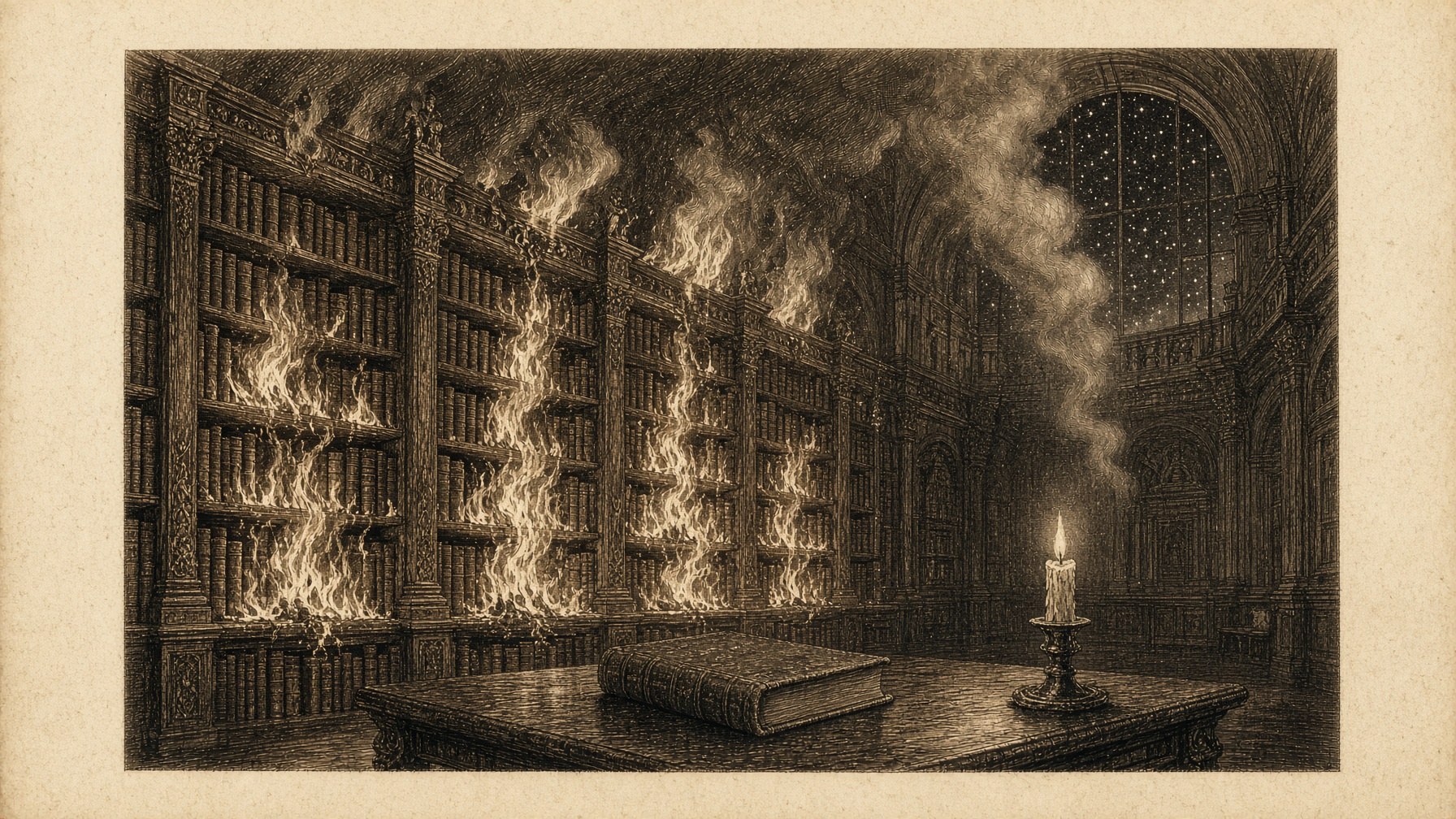
A library can burn.
Generated interpretationOne plate. A generated engraving of a library on fire. Not a photograph of Alexandria, and not a second fire stacked beneath it.
Remember
A phrase travels through several mouths. This tiny simulation does not reproduce oral epic. It only shows, in miniature, that transmission both keeps and changes.
Sing, goddess, the anger of Achilles son of Peleus.
First voice. A famous opening, already a request to remember.
Carry
Choose one fragment. It will return at the end of the walk. Nothing else is stored. This is only a demonstration of persistence, not a reconstruction of oral culture.
III · Nine nights
Mythic
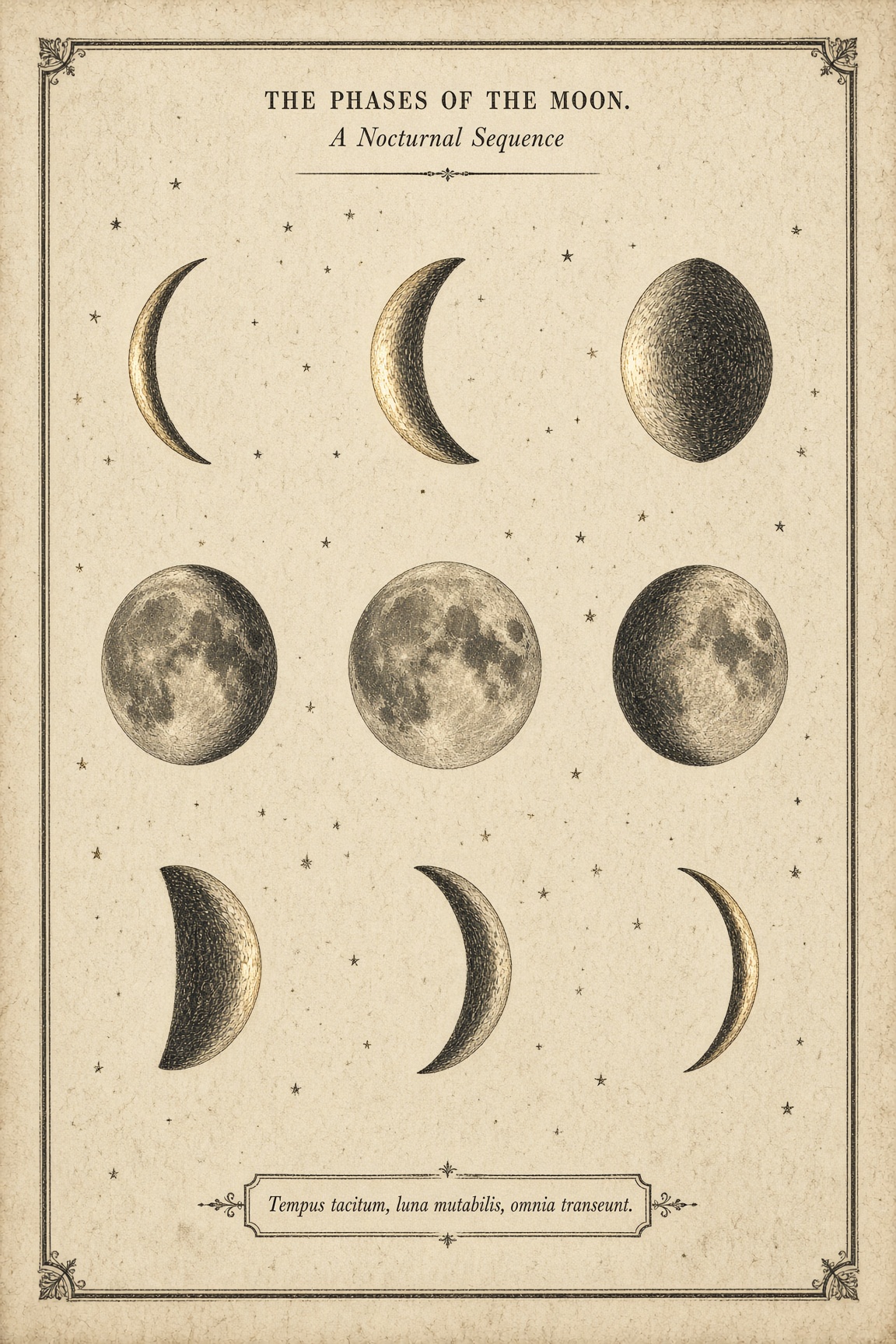
Hesiod is brief, and the briefness is the tone. Mnemosyne, who reigns over the hills of Eleuther, bore the Muses in Pieria, mingling with the father, Cronus’ son: “a forgetting of ills and a rest from sorrow.” For nine nights counselor Zeus lay with her, entering her holy bed remote from the immortals. When a year had passed, she bore nine maidens, like-minded, whose hearts are set upon song.
The story is not a romance. It is a genealogy of arts. Time is the plot: nine nights, then a year, then multiplicity. Memory does not give birth to one art. She gives birth to many ways of making experience endure.
Nine nights. Then a year. Then nine maidens, all of one mind.
IV · Daughters of memory
9
daughters
Hesiod names nine. He does not yet hand each a modern job title. The familiar list (epic, history, lyric, music, tragedy, hymn, dance, comedy, astronomy) is a later convention. It is still useful, if we keep the date-stamp on it.
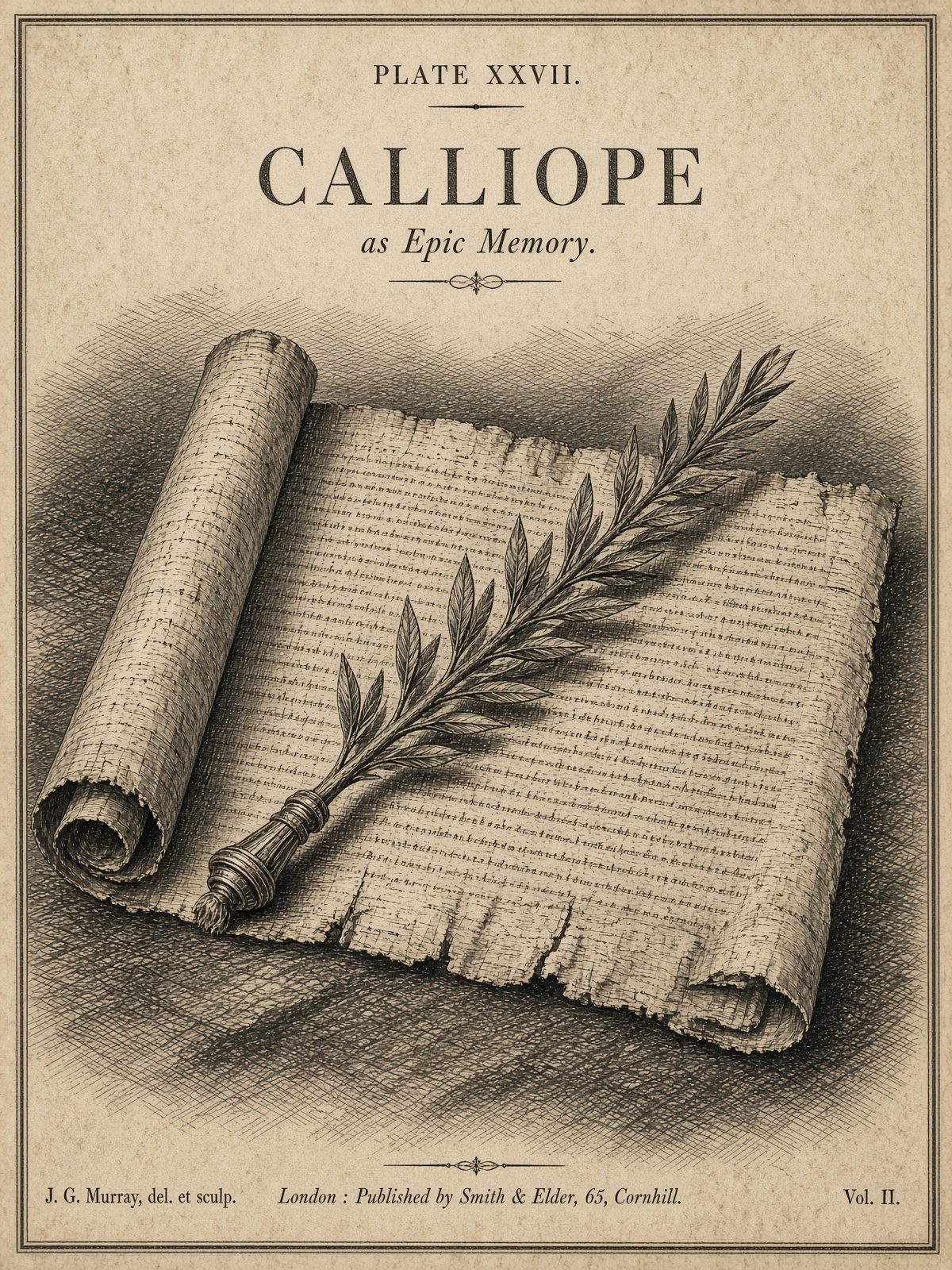
Καλλιόπη
Memory made epic: a culture’s long story held in verse that can be performed again.
Beautiful-voiced. Hesiod names her greatest of the nine, because she attends upon kings.
Later conventionLater convention: epic poetry.
Ancient basisHesiod, Theogony 79–80, names Calliope without assigning “epic” as a later catalogue would. The domain-list is a historical development, not the earliest Greek picture.
Generated interpretationGenerated interpretation of later attributes. Not an ancient portrait of Calliope.
What does each Muse allow human beings to preserve?
V · Before there were nine
Mythic
Pausanias, writing in the second century CE, reports a local Heliconian tradition: the sons of Aloeus held that the Muses were three, and named them Melete (Practice), Mneme (Memory), and Aoede (Song). Later, he says, Pierus the Macedonian came to Thespiae and established nine, changing the names to the present ones.
Mimnermus, Pausanias adds, distinguished elder Muses, daughters of Uranus, from younger Muses, children of Zeus. Cicero knows still other early names. Variation is not an error in the file. Variation is how a culture remembers by reshaping.
Myth itself has a memory.
Practice. Memory. Song. Before the canonical nine, a shorter grammar already said the whole office: you must work, you must remember, you must give the thing a voice.
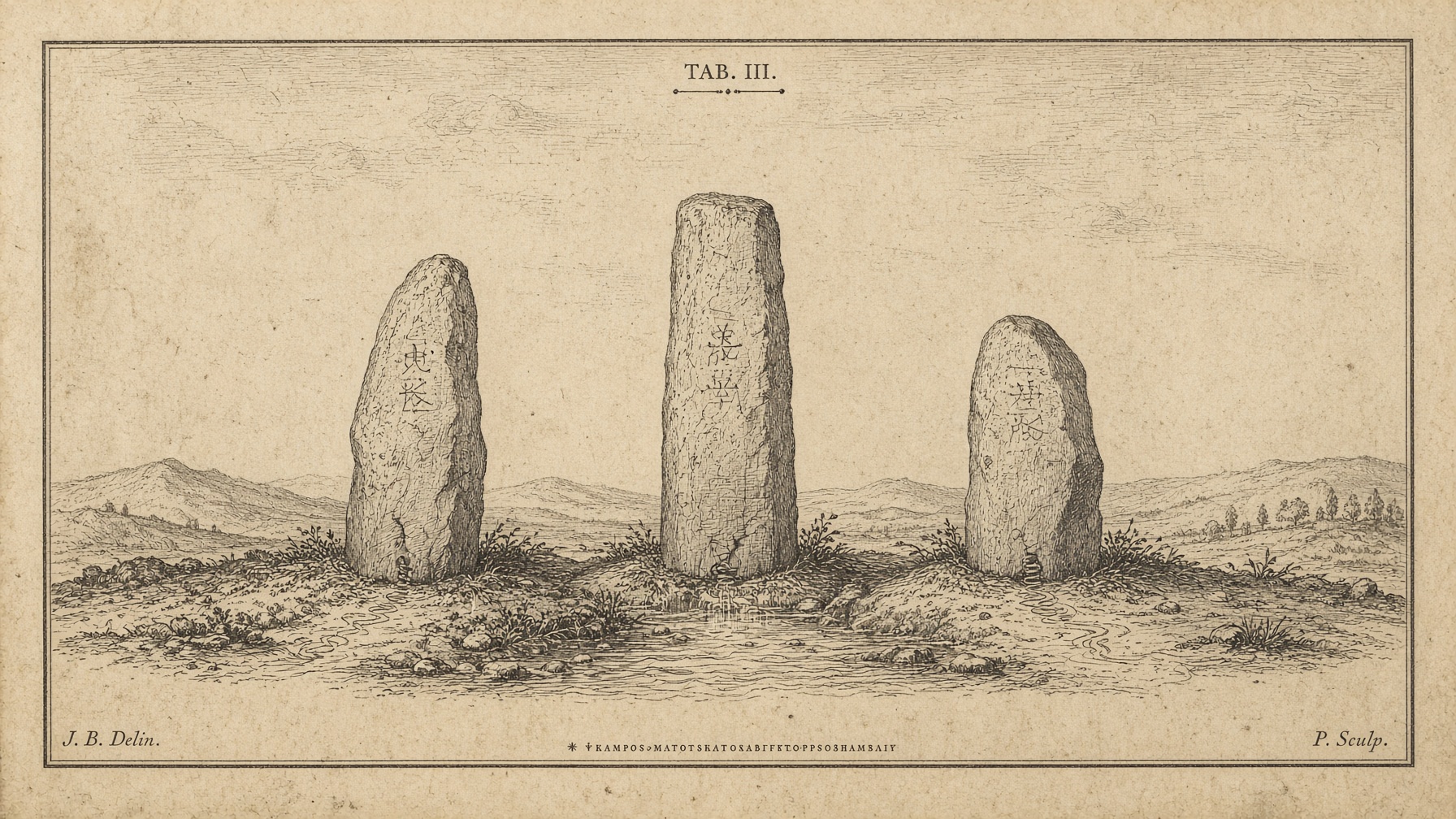
Generated interpretationNot an archaeological photograph of Heliconian cult stones. A modern plate for a reported triad.
Practice
The work of repeating until a form will hold.
Memory
The work of carrying what practice learned.
Song
The work of giving the carried thing a voice.
VI · A small note in the margin
After the myth has earned its own importance, a later correspondence appears in the English spelling. These are modern English-letter ciphers. They are not ancient Greek numerology. They are not evidence that Hesiod encoded a number. They are a noticing.
English ordinal
123
Full reduction
42
MNEMOSYNE
123 | 42
English ordinal · A=1 … Z=26
| M | N | E | M | O | S | Y | N | E | Sum |
|---|---|---|---|---|---|---|---|---|---|
| 13 | 14 | 5 | 13 | 15 | 19 | 25 | 14 | 5 | 123 |
Full reduction · A=1 … I=9, then repeating
| M | N | E | M | O | S | Y | N | E | Sum |
|---|---|---|---|---|---|---|---|---|---|
| 4 | 5 | 5 | 4 | 6 | 1 | 7 | 5 | 5 | 42 |
Spelling preserved exactly. Independently recalculated. A noticing in English letters, not a Greek encoding, not a cause.
NINE
42 | 24
| N | I | N | E | Sum |
|---|---|---|---|---|
| 14 | 9 | 14 | 5 | 42 |
The number did not make her Memory. Memory made us look again.
The myth is Greek. The correspondence was noticed later. She is the mother of nine Muses. That is already enough.
VII · Invocation
The request is already a theory of memory.
Mythic
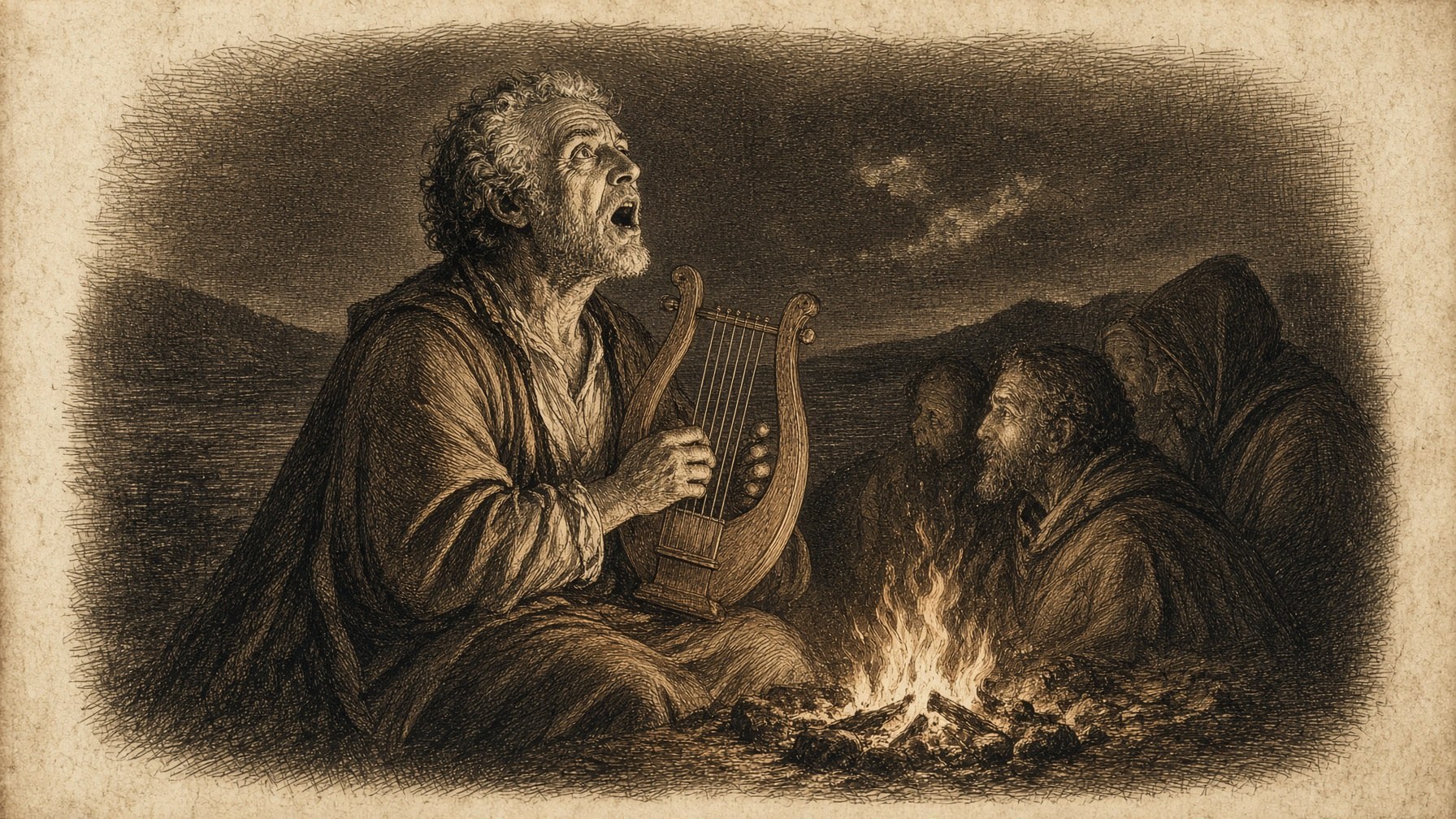
Iliad 1.1
“Sing, goddess, the anger of Achilles son of Peleus, that brought countless ills upon the Achaeans.”
Odyssey 1.1
“Tell me, Muse, of the man of many ways, who was driven far after he sacked the sacred citadel of Troy.”
Sing, goddess, the anger of Achilles son of Peleus.
Helicon
Hesiod says the Muses taught him song while he shepherded lambs. They addressed him as a belly, a thing of the field, and then gave him a staff of laurel and a voice. Neither Homer nor Hesiod opens with a private store. Each asks.
True and false
They know how to say many false things that seem true, and they know, when they wish, to speak what is true. They tell of what is, what will be, and what was before. Memory here is not a filing cabinet. It is a relation.
Invocation is the astonishing idea that a poet begins by requesting help to remember.
What must be sung is larger than one mouth, and must be called. The goddess is asked because the story already exists in the culture’s mouth.
Generated interpretationModern plate of a singer at work. Not a documented rhapsode, and not a photograph of a particular night.
VIII · The two waters
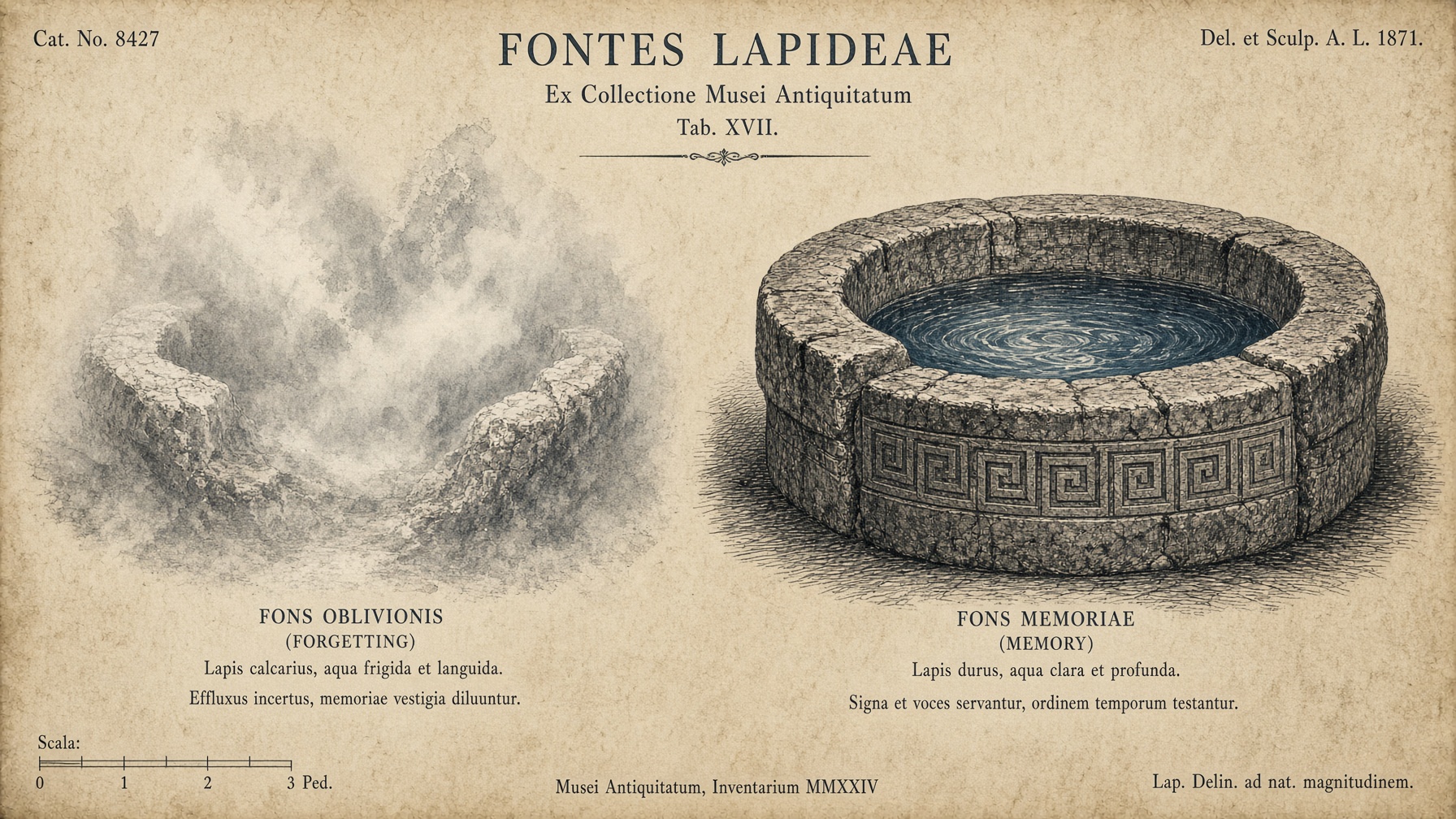
Do not freely combine Greek traditions as though one mythology described them identically. Waters of memory and forgetfulness appear in more than one place, with more than one job.
The Hipponion tablet (c. 400 BCE) begins, in one reading: this is the work of Mnemosyne. The soul is told of a spring on the right with a white cypress, where the dead refresh themselves, and is told not to go near it. Further on, cold water from the lake of Memory, with guardians. The password is genealogy: I am a child of Earth and starry Heaven.
Do not say “the Orphics believed X” as if the tablets were a church creed. They are a family of objects with related instructions.
Sometimes forgetting is mercy. Sometimes memory is duty.
Sometimes forgetting is mercy. Sometimes memory is duty.
Generated interpretationModern plate, shown whole. Not a photograph of the Lebadeia fountains or of a gold tablet.
IX · Memory is not a recording
Scientific
At an intelligent-reader level, remembering has stages that are easy to name and hard to finish: encoding, consolidation, retrieval. What arrives again is often a reconstruction, shaped by present context and emotion, not a replay of a stored film.
Bartlett showed, already in 1932, that recall reorganizes. That does not mean all memories are false. Reconstructive is not a synonym for invented. Distortion is a measured phenomenon. So is remarkable accuracy. Forgetting is a feature as well as a failure; without it, the present would drown.

Generated interpretationModern plate. Not a laboratory photograph. Reconstruction is already inside the instrument.
A sequence, not a machine drawing of the brain. Source: standard cognitive vocabulary. Simplification: arrows hide loops, reconsolidation, and emotion.
01
Encoding
Experience is taken in, not photographed.
Observed process · simplified
02
Consolidation
What was taken in is stabilized, often over time and sleep.
Experimentally supported · model still debated
03
Retrieval
The past is summoned in a present context.
Observed process
04
Reconstruction
What returns is assembled, not merely replayed.
Experimentally supported · not ‘all memories are false’
What to notice: retrieval is not the last box. Reconstruction is already inside it.
Does memory only preserve experience,
or does it help re-make it?
Observed / experimentally supportedEncoding, consolidation, retrieval, and reconstructive effects are experimental fields, not metaphors borrowed from myth. Models of how this happens in tissue continue to change.
Interpretation / openIf recall helps create the present each time the past is summoned, Mnemosyne becomes stranger, not smaller. The ancient story asked something enduring. Modern disciplines let us ask it differently. Neither explains the other away.
X · The self in time
Treat that sentence as philosophical and editorial unless a particular science supports stronger wording.
Open
Locke tied personal identity to consciousness extended backward through memory. Later philosophers (Reid, Butler, Parfit) asked what happens when memory is incomplete, false, or interrupted. Who are you without a remembered yesterday?
Scientific
Autobiographical memory is not a box of days. It is a system that constructs a life story: selective, emotional, revised. Continuity of self depends on it, but is not identical with a perfect record.
Scientific
When autobiographical memory is damaged, something of a person remains: skills, temperament, the ability to be present. Something is also missing: the felt through-line. Clinical cases are not curiosities. They are evidence that “I” is partly a remembered work.
Who are you without a remembered yesterday?
A self can survive when autobiographical memory changes. It does not survive unchanged. Myth is not a diagnosis, and a patient is not a cabinet of wonders. The question is consciousness: how much identity is a carried past.
XI · Memory leaves the body
Cultural
Human beings learned to store memory outside themselves. Voice. Mark. Inscription. Scroll. Book. Library. Image. Notation. Photograph. Recording. Film. Database. Network. Model. This is not a simple march of progress. Each medium preserves something, loses something, changes something, makes something newly searchable, and changes who may remember, and who controls the archive.
Plato already worried, in the Phaedrus, that writing would offer the appearance of wisdom without the interior work of remembrance. He was not simply anti-book. He was asking what a technology of memory does to a soul. The question did not end with papyrus.
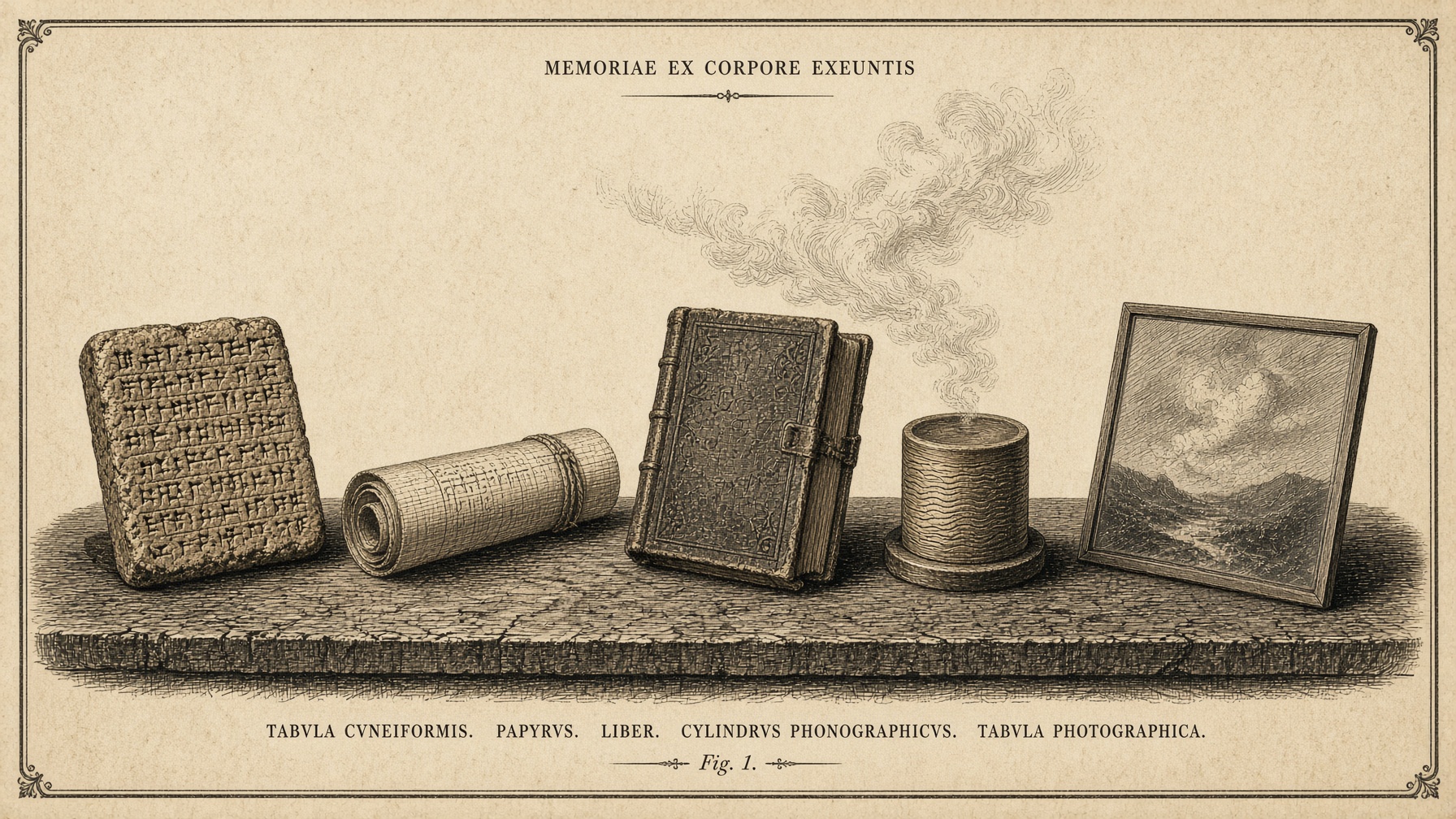
Generated interpretationModern engraving-style still life. Not a museum photograph of a single historical desk.
The archive
Not a progress bar. Each step is a different kind of remaining.
Open: what should we preserve, and who decides? This room is not an advertisement for any company, model, or public figure. It is the old problem in a new place: memory looking for somewhere to live.
The Horizon → Entropy · information · what physics means by preservation
XII · A culture remembers
Cultural
Collective memory is not a biological storage system. Cultures do not possess a single brain. They possess rituals, monuments, stories, archives, histories, names, songs, memorials, calendars, genealogies, museums, books, and the living work of telling children. The analogy is useful only if it stays an analogy.
And the living work of telling children.
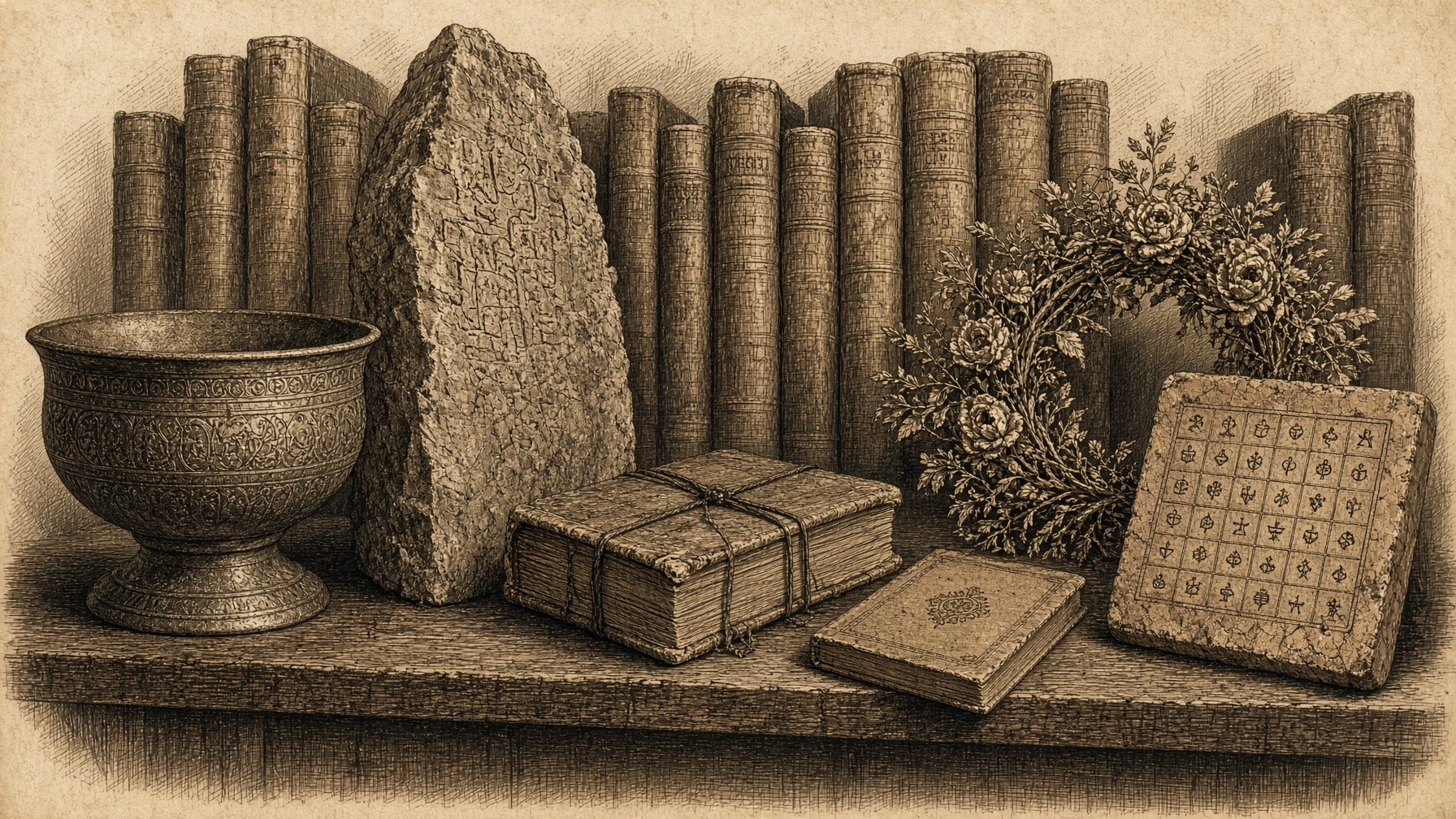
Generated interpretationModern museum plate. Not a single historical collection.
XIII · What gets forgotten?
Memory has power.
Cultural
Who was allowed to write? Whose songs were copied? Whose names entered the archive? What disappeared because nobody preserved it? What disappeared because preservation was forbidden? What survives accidentally? What survives because someone loved it enough to carry it?
Linear B clay tablets survived because a palace burned: fire baked the records that ordinary weather would have returned to mud. Sappho remains mostly as fragments, quoted by others. Whole languages stop being spoken and take their unwritten stores with them. The Library of Alexandria is famous for loss; most loss is quieter than a fire.
What are we trying not to lose?
Physical entropy is not forgetting. A memory is not a thermodynamic quantity. But living systems spend extraordinary effort carrying information forward, and human beings go further, turning memory into story, monument, song, archive, and art. Everything preserved requires work. A voice must be repeated. A manuscript must be copied. A photograph must be kept. A language must still be spoken. An archive must be maintained.
XIV · Memory creates
Open
That remains open.
Poetry is not produced from nothing.
Music is not produced from nothing.
History is not produced from nothing.
Dance carries learned form.
Comedy remembers what a society still recognizes.
Tragedy returns old stories to a new audience.
Astronomy accumulates observation across generations. Creativity transforms what has been carried forward. Do not claim all creativity is reducible to memory. The question is stricter than a slogan.
Calliope
Memory made epic: a culture’s long story held in verse that can be performed again.
Clio
Memory made history: deeds kept as a public past, not only as a song.
Erato
Memory made desire sing: what the body felt, held as verse.
Euterpe
Memory given breath and music: air shaped so a phrase can be found again.
Melpomene
Memory given tragedy: old suffering returned to a new audience so it can be shared.
Polyhymnia
Memory made sacred utterance: what a people says when ordinary speech is not enough.
Terpsichore
Memory carried by the moving body: steps that survive only if they are done again.
Thalia
Memory that survives through laughter: what a society must still recognize in order to find it funny.
Urania
Memory turned toward the ordered heavens: what no single lifetime is long enough to finish watching.
XV · The mother of the Muses
Why did a Greek genealogy place the Muses after Mnemosyne? Do not give one dogmatic answer. Let source, cultural function, and interpretation sit beside each other.
Mythic
Hesiod’s story: nine nights, nine daughters whose hearts are set upon song, who tell what is, what will be, and what was. The genealogy is already an argument: arts come after memory.
Cultural
Song must be remembered. History must be carried. Names vanish without repetition. A culture cannot create from a past it cannot reach. Even imagination needs something from which to depart.
Open
Perhaps the ancients understood something we keep rediscovering: before we create, we carry. Perhaps they only named a power they could not afford to lose. The two readings can live together.
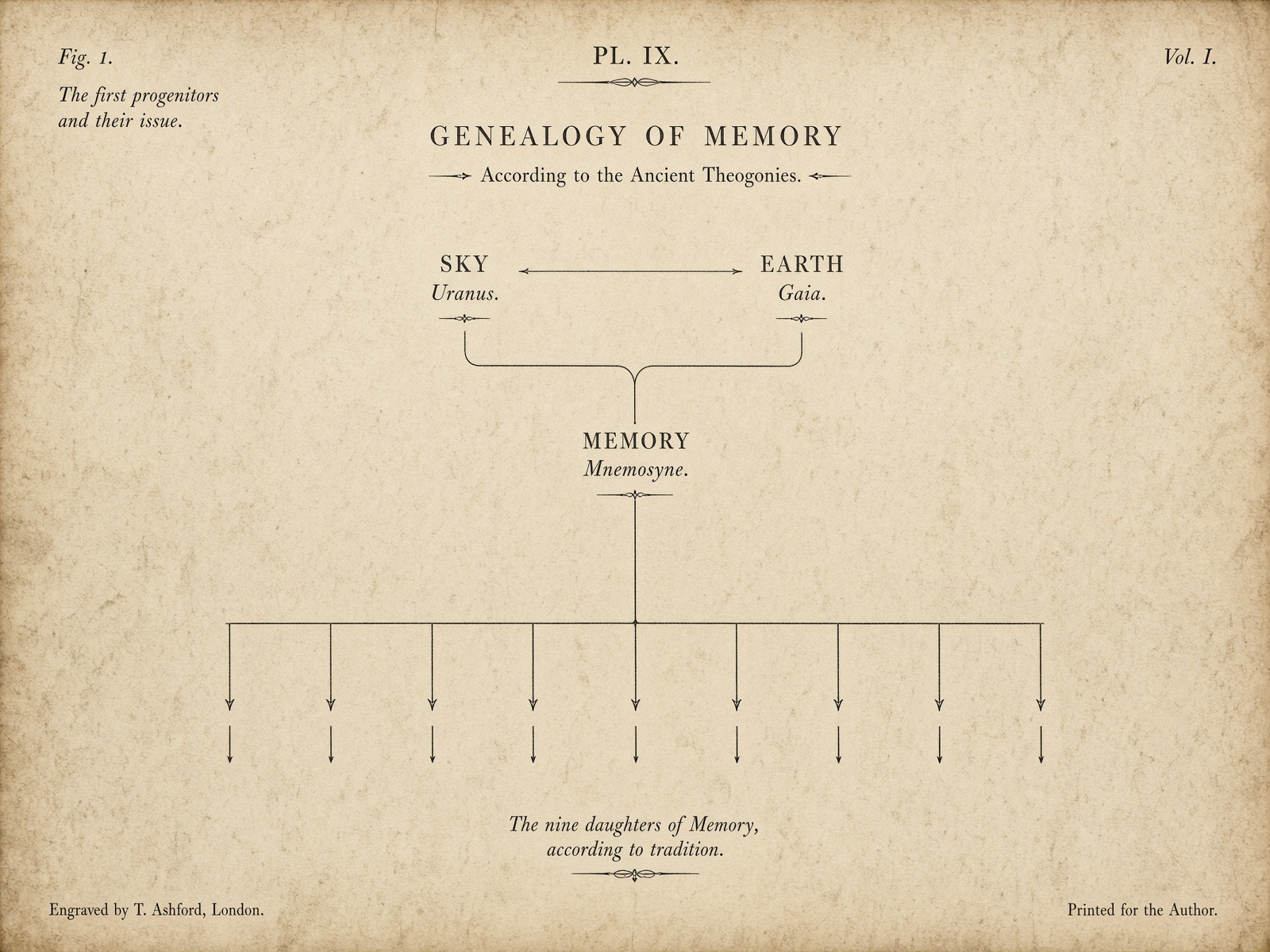
Generated interpretationEditorial diagram, not an ancient stemma. Simplification: many variant parentages omitted.

XVI · Return
Before history, someone remembering.
Before the archive, someone carrying the story.
What we remember can outlive us.
You carried nothing through the rooms. That, too, is a kind of answer.
Before song, memory. What we remember can outlive us.
She was the mother of the Muses. Perhaps the ancients understood something: before we create, we carry.
What must be remembered?
Generated interpretationClosing plate: generated engraving of the opening library at first light. Shown whole. Not an ancient artifact.